
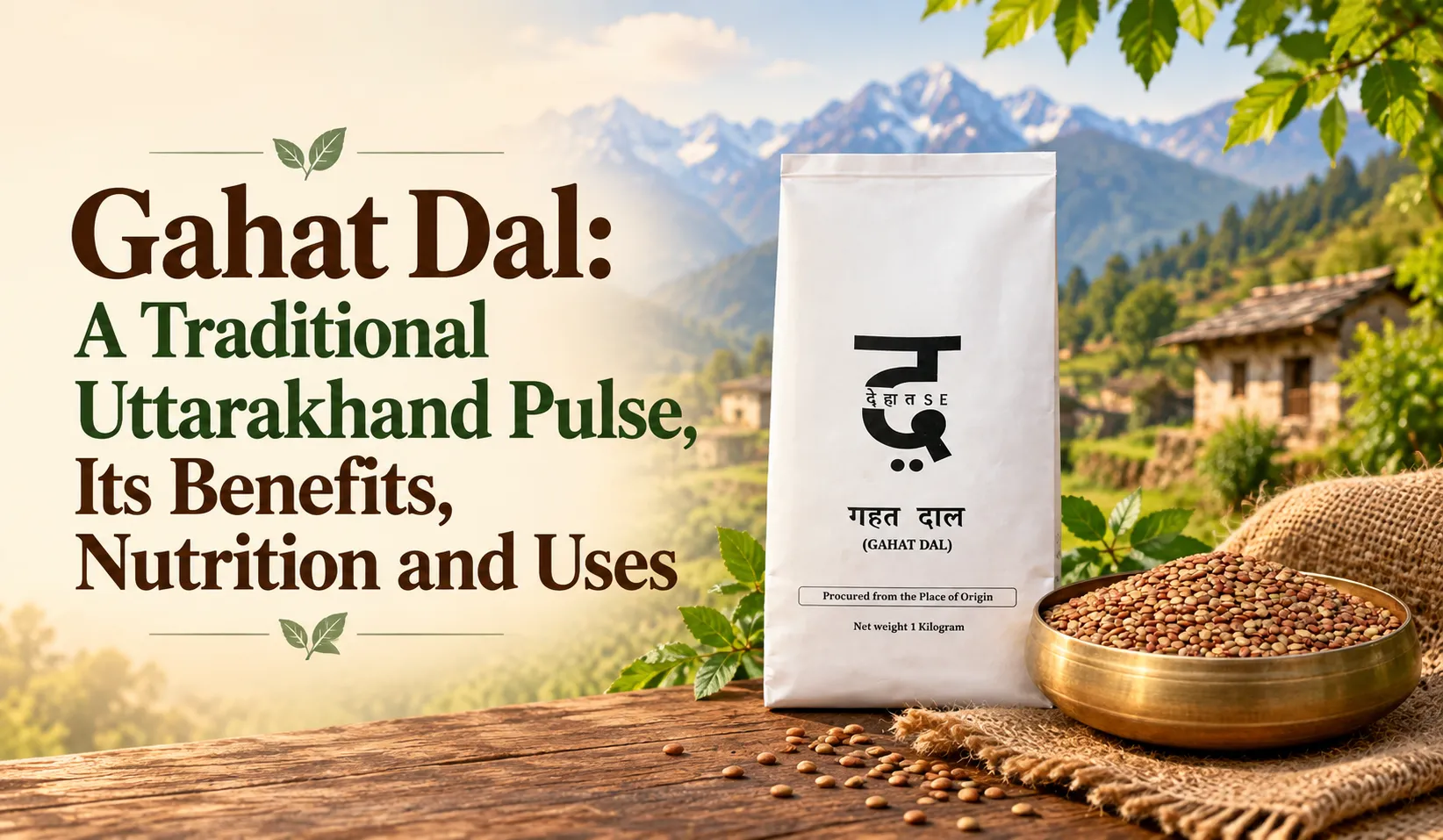
Gahat Dal is a traditional pulse widely associated with the food culture of Uttarakhand and other parts of India. Also known as horse gram, and commonly called Kulthi or Kulath in different regions, it is a small, hardy legume used in dals, soups, curries and several regional dishes.
In Uttarakhand, Gahat has a particularly strong culinary identity. It is used in traditional preparations such as Gahat Ki Dal and Gahat Ka Fanu, where its earthy flavour and thick texture work well with simple spices and local cooking styles.
Like other pulses, Gahat Dal is valued nutritionally for its plant-based protein, dietary fibre, carbohydrates and naturally occurring minerals. Its nutritional qualities, however, are only one part of its appeal. Its connection with mountain agriculture and traditional Uttarakhand cuisine makes it interesting for anyone exploring regional Indian foods.
In this guide, we look at what Gahat Dal is, what it is called in English, where it is grown, how it is traditionally used, how to cook it, its nutritional qualities, how it compares with other dals and how to choose and store good-quality Gahat.
What is Gahat Dal?
Gahat Dal is the local name used in Uttarakhand for horse gram, a pulse belonging to the legume family. Its accepted botanical name is Macrotyloma uniflorum.
Horse gram is cultivated and consumed in several regions of India, although the names and recipes associated with it vary from place to place.
The dried seeds are relatively small and may occur in brown, reddish-brown or darker shades depending on the variety. Once properly soaked and cooked, they soften and can be used to prepare dal, curries and thicker traditional dishes.
What makes Gahat particularly interesting in Uttarakhand is its regional identity. It is not simply consumed as another pulse; it forms part of a wider tradition of local ingredients and mountain cooking.
For people unfamiliar with it, Gahat can be thought of as a traditional Indian pulse with an earthy flavour and a somewhat different texture from commonly eaten dals such as moong or masoor.
What is Gahat Dal Called in English?
Gahat Dal is commonly known as Horse Gram in English.
Its scientific name is Macrotyloma uniflorum.
Depending on the region and language, horse gram may also be known by names such as:
- Gahat
- Kulthi
- Kulath
- Kollu
- Hurali
- Ulavalu
The terminology varies across India.
In Uttarakhand, Gahat is one of the names strongly associated with the pulse and its traditional preparations.
Therefore, if you see “Gahat Dal” and “Horse Gram” being discussed together, they generally refer to the same type of pulse. Regional varieties and cultivation conditions, however, can create differences in appearance and cooking characteristics.
Gahat Dal in Uttarakhand
Gahat has a well-established place in Uttarakhand’s regional cuisine.
Mountain food traditions are closely linked with crops that can be grown under local climatic and agricultural conditions. Pulses, grains and other foods that can be dried and stored also have practical importance in household food systems.
Gahat is used in several Uttarakhand dishes, ranging from relatively simple dal preparations to thicker dishes such as Fanu or Phanu.
Its place in local cooking also demonstrates how one ingredient can take on different identities in different regions.
While horse gram is consumed elsewhere in India, the word “Gahat” and dishes prepared from it are particularly familiar in Uttarakhand.
For someone exploring traditional Uttarakhand food, Gahat is therefore an ingredient worth knowing alongside the region’s other pulses, grains and local preparations.
Where is Gahat Dal Grown?
Horse gram is grown in different parts of India and is known as a relatively hardy pulse crop.
Its cultivation is not limited to Uttarakhand. Different varieties and local forms are grown across several Indian states, particularly in areas where the crop fits local rain-fed agricultural systems.
In Uttarakhand, Gahat is associated with traditional hill agriculture and local food habits.
Growing Conditions in Uttarakhand
Agriculture in Uttarakhand varies considerably depending on location, elevation, rainfall, soil and access to irrigation.
The state’s mountain geography means that farming conditions cannot be described by one single pattern.
In suitable areas, pulses such as Gahat can form part of local cropping systems.
Important factors affecting the crop include:
- Temperature
- Rainfall
- Soil conditions
- Availability of moisture
- Sowing period
- Local elevation
- Seed variety
- Agricultural practices
Horse gram is generally considered a hardy crop and can be grown under comparatively low-input and rain-fed conditions in suitable environments.
This characteristic has contributed to its cultivation in several parts of India.
However, the characteristics of harvested Gahat can still differ between regions and farms. Seed variety, rainfall, soil, harvest timing and storage can all influence the final product.
How is Gahat Dal Cultivated?
The exact cultivation process varies according to location and farming system.
Generally, farmers prepare suitable land before sowing horse gram seeds during the appropriate growing period.
The crop then develops through its vegetative and flowering stages before pods mature.
Traditional Farming and Harvesting
A simplified cultivation and post-harvest process includes:
Land preparation
The field is prepared according to local soil conditions and the farming system being followed.
Sowing
Seeds are sown during the suitable agricultural season.
Sowing time can differ depending on rainfall, altitude and local climate.
Crop growth
The plants develop and eventually produce pods containing the seeds.
Farm management practices vary according to the farm and region.
Harvesting
Once the crop reaches maturity, it is harvested.
Drying
The harvested crop is dried sufficiently before the seeds are separated and stored.
Threshing and cleaning
The seeds are separated from the dried plant material and cleaned to remove unwanted matter.
Storage
Properly dried seeds are stored away from excess moisture and insects.
Drying is particularly important for pulses because excessive moisture can reduce storage quality and encourage spoilage.
What Does Gahat Dal Look and Taste Like?
Gahat Dal looks noticeably different from many split dals commonly used in Indian kitchens.
The whole seeds are relatively small and can range from light brown to reddish-brown or darker shades depending on the variety.
Natural agricultural products may not always have perfectly identical colour, shape or size.
Flavour and Texture
Gahat has an earthy and robust flavour.
Its taste works particularly well with simple Indian spices, garlic, cumin, coriander and other ingredients commonly used in regional cooking.
The texture depends greatly on preparation.
Before cooking, the dried seeds are hard. After soaking and sufficient cooking, they soften considerably.
Depending on the recipe, cooked Gahat can be kept relatively whole or mashed and simmered to create a thicker consistency.
This ability to create a substantial, thick preparation makes it suitable for traditional dishes such as Gahat Ki Dal and Fanu.
What Makes Uttarakhand Gahat Dal Different?
Horse gram is grown in several parts of India, so Gahat from Uttarakhand should not automatically be considered a completely different species of pulse.
Its distinction comes primarily from its regional identity, local cultivation and culinary tradition.
In Uttarakhand, Gahat is connected with:
- Traditional hill agriculture
- Regional household cooking
- Local recipes
- Uttarakhand food culture
- Generations of culinary use
The ways in which Gahat is cooked are particularly important.
A regional ingredient is defined not only by where it grows but also by how people use it.
Dishes such as Gahat Ki Dal and Gahat Ka Fanu give the pulse a recognizable place in Uttarakhand cuisine.
Growing conditions can also influence agricultural produce. However, claims that Uttarakhand Gahat is automatically nutritionally superior to horse gram grown elsewhere should be treated cautiously unless supported by direct comparative evidence.
Its strongest distinction is its relationship with the region and its food traditions.
How to Cook Gahat Dal
Gahat is a dried pulse and needs adequate cooking before it is eaten.
Soaking before cooking is a convenient approach because it hydrates the dried seeds and can help reduce the time required for cooking.
Step 1: Sort and Wash
Spread the Gahat on a clean plate or tray.
Check for:
- Small stones
- Damaged seeds
- Dust
- Plant material
- Other foreign particles
Remove anything unwanted.
Transfer the Gahat to a bowl and rinse thoroughly with clean water.
Step 2: Soak the Gahat
Cover the washed Gahat with sufficient water and allow it to soak.
Overnight soaking is convenient when preparing the dish the following day.
The seeds absorb water during this period and begin to soften.
Drain the soaking water before cooking and use fresh water.
Step 3: Cook Until Tender
Transfer the soaked Gahat to a pressure cooker and add fresh water.
Cook until the seeds are completely tender.
Cooking time can vary considerably depending on:
- Seed variety
- Age of the pulse
- Length of soaking
- Storage conditions
- Cooking method
Therefore, tenderness is a better guide than relying only on a fixed cooking time.
The cooked Gahat should not remain unpleasantly hard in the centre.
Step 4: Prepare the Seasoning
Depending on the recipe, seasonings can include:
- Cumin
- Garlic
- Ginger
- Coriander
- Turmeric
- Chilli
- Onion
- Tomato
- Asafoetida
Traditional recipes vary from household to household, so there is no need to treat one masala combination as the only authentic version.
Step 5: Combine and Simmer
Combine the cooked Gahat with the prepared seasoning.
Allow everything to simmer together so the flavours combine.
For a thicker dal, some of the cooked Gahat can be lightly mashed.
Adjust water and seasoning according to the desired consistency.
Serve warm with rice or roti.
Traditional Uttarakhand Gahat Dal Recipes
One of the best ways to understand Gahat is through the dishes in which it is traditionally used.
Uttarakhand cuisine has several preparations associated with the pulse.
Gahat Ki Dal
Gahat Ki Dal is a straightforward way to prepare horse gram.
The pulse is cleaned, soaked where desired, cooked until tender and seasoned with spices.
Depending on household tradition, garlic, cumin and other seasonings may be used.
The result is an earthy, warming dal that can be eaten with rice or roti.
The exact preparation varies between families and areas, which is common with traditional regional recipes.
Gahat Ka Fanu or Phanu
Fanu, also spelled Phanu, is a well-known preparation associated with Uttarakhand cuisine.
Pulses are soaked and processed before being cooked into a relatively thick dish. Gahat is one of the pulses that can be used for this preparation.
The resulting dish has a substantial consistency and allows the flavour of the pulse to remain prominent.
It is generally eaten as part of a meal with rice or other accompaniments.
Regional recipes can vary, so ingredients and techniques are not necessarily identical in every household.
Gahat Ke Paranthe
Gahat can also be used in preparations such as stuffed parathas.
Cooked Gahat can be combined with suitable seasonings and incorporated into a filling before being used in the dough or stuffing, depending on the recipe.
The earthy taste of the pulse works well with simple spices.
Other Ways to Use Gahat
Although its traditional recipes are particularly interesting, Gahat can also be incorporated into contemporary cooking.
Possible preparations include:
- Dal
- Thick curries
- Soups
- Mixed pulse dishes
- Stuffed flatbreads
- Pulse-based bowls
- Salads using properly cooked horse gram
People trying Gahat for the first time may want to begin with a simple dal to understand its natural flavour and texture.
Nutritional Value of Gahat Dal
Gahat, like other pulses, contributes several nutrients to the diet.
The precise nutritional composition depends on factors such as variety, growing conditions, processing and whether values are measured for raw or cooked seeds.
Horse gram is generally recognized as a source of:
- Plant-based protein
- Dietary fibre
- Carbohydrates
- Minerals
- Naturally occurring micronutrients
The nutrient concentration of dry Gahat will not be the same as an equal weight of cooked Gahat because cooking causes the seeds to absorb water.
For this reason, nutritional figures should always be interpreted according to whether they refer to dry or cooked horse gram.
Plant-Based Protein
Pulses are important plant sources of protein, and Gahat is no exception.
It can contribute to daily protein intake, particularly in diets that regularly include beans, lentils and other pulses.
Protein requirements, however, should ideally be met through a varied diet rather than relying on one food.
Dietary Fibre
Gahat also contains dietary fibre.
Pulses are a practical way of adding fibre-containing foods to meals.
Combining pulses with vegetables, whole grains, fruits and other appropriate foods can contribute to an overall varied eating pattern.
Carbohydrates
Like other pulses, Gahat also provides carbohydrates.
This contributes to the energy value of the food and helps make Gahat-based meals substantial.
Minerals
Horse gram naturally contains minerals, although the exact amounts vary.
Rather than treating Gahat as a supplement or medicine, it is more useful to consider it one of several nutrient-containing foods that can form part of a balanced diet.
What Are the Benefits of Gahat Dal?
Gahat is sometimes associated online with a very long list of health claims.
It is important to separate the established nutritional qualities of the pulse from exaggerated or medical claims.
Source of Plant-Based Protein
Gahat provides plant-based protein.
This makes it useful for people who include pulses as part of vegetarian or plant-focused meals.
It can be combined with grains and vegetables to create a more varied meal.
Provides Dietary Fibre
Gahat naturally contains dietary fibre.
Including pulses in the diet can help increase the variety of fibre-containing foods being consumed.
Provides Naturally Occurring Nutrients
Horse gram contains carbohydrates, protein, fibre and naturally occurring minerals.
The precise nutritional profile depends on the variety and preparation method.
Can Make Meals Satisfying
Pulses combine protein, carbohydrates and fibre, which makes them useful ingredients for substantial meals.
A bowl of Gahat Dal served with rice or roti and vegetables can form part of a balanced meal.
Adds Variety to the Diet
One practical benefit of Gahat is that it adds another pulse to the range of foods available in the kitchen.
Instead of depending only on moong, masoor, chana and toor dal, households can rotate different pulses.
Dietary variety can make meals more interesting while providing nutrients from different food sources.
What Gahat Dal Should Not Be Treated As
Traditional foods are sometimes promoted online with claims that they can cure particular diseases.
Gahat should not be treated as a substitute for medical treatment.
Claims that horse gram can cure kidney stones, diabetes, obesity or other diseases should not be accepted simply because the ingredient has a history of traditional use.
Scientific research has investigated different components and potential effects of horse gram, but that is not the same as proving that eating Gahat can treat or cure a medical condition.
People managing a medical condition should follow advice from an appropriately qualified healthcare professional rather than relying on a particular food as treatment.
Gahat Dal in Uttarakhand Food Culture
Gahat’s importance becomes clearer when it is viewed as part of a regional food system rather than simply as another packaged pulse.
Traditional mountain cuisines developed around ingredients that were locally available and suitable for household use.
Pulses are particularly practical because dried seeds can be stored and cooked when required, provided they are kept under suitable conditions.
In Uttarakhand, Gahat became part of recipes adapted to local ingredients and cooking habits.
Gahat Ki Dal and Fanu are examples of this relationship between an agricultural crop and regional cuisine.
Today, people living outside Uttarakhand can also cook these dishes, allowing regional ingredients and recipes to reach a much wider audience.
For people interested in Indian regional food, trying Gahat is therefore also a way of exploring a part of Uttarakhand’s culinary tradition.
Gahat Dal vs Regular Dal
There is no single product called “regular dal.”
Indian households use many pulses, including moong, masoor, toor, urad and chana.
Each has its own flavour, texture and cooking behaviour.
| Feature | Gahat Dal | Common Household Dals |
|---|---|---|
| Common English name | Horse Gram | Depends on the pulse |
| Appearance | Small whole seeds | Varies considerably |
| Colour | Often brown to reddish-brown | Yellow, green, orange, black and other colours |
| Flavour | Earthy and robust | Varies by pulse |
| Texture | Substantial when cooked | Varies from light to creamy |
| Preparation | Often soaked and thoroughly cooked | Depends on the dal |
| Uttarakhand use | Strong regional association | Varies |
| Traditional dishes | Gahat Ki Dal, Fanu and others | Numerous regional dishes |
| Nutritional role | Source of protein, fibre and carbohydrates | Most pulses also provide protein, fibre and carbohydrates |
The difference is therefore not that Gahat is automatically “better” than other dals.
It provides a different flavour, texture and culinary tradition.
Rotating different pulses can be more useful than trying to identify one “best” dal.
Gahat Dal vs Kulthi Dal: Are They the Same?
In general, Gahat and Kulthi refer to horse gram, although the preferred name varies according to region and language.
In Uttarakhand, the term Gahat is commonly used.
Elsewhere in India, Kulthi or other regional names may be more familiar.
This can cause confusion when shopping online because the same pulse may appear under different product names.
If you are unsure, look for the English name Horse Gram and, where available, the botanical name Macrotyloma uniflorum.
However, the same species can include different varieties and locally adapted forms, so two packets from different growing regions may not necessarily look completely identical.
How to Choose Good Quality Gahat Dal
Good-quality dried Gahat should be clean, properly dried and free from obvious signs of deterioration.
Before buying loose Gahat, look at the overall condition of the seeds.
Look for:
- Clean grains
- Properly dried seeds
- Natural colour
- Minimal damaged seeds
- No visible mould
- No insect infestation
- No unusual moisture
- Minimal stones and foreign material
- No strong musty or unpleasant smell
Natural differences in size or shade are not necessarily a quality problem.
Agricultural produce can show some variation between batches.
When Buying Packaged Gahat Dal
Check the package for:
- Product name
- Net quantity
- Source or origin information
- Packing/manufacturing details
- Best-before information
- Storage instructions
- Manufacturer or seller details
- Required food-safety information
- Condition of the packaging
Avoid damaged packages or products showing obvious signs of moisture or infestation.
How to Identify Authentic Uttarakhand Gahat Dal
It can be difficult to establish geographical origin simply by looking at dried seeds.
Colour and size alone are not reliable proof that a packet of Gahat comes from Uttarakhand.
Instead, check the product’s sourcing information.
Useful details may include:
- State or region of origin
- Sourcing location
- Producer information
- Seller information
- Packaging details
- Traceability information, where available
If a seller markets a product specifically as “Uttarakhand Gahat Dal,” there should ideally be meaningful information supporting that regional connection.
Attractive packaging by itself does not establish origin.
Clear sourcing information is more useful.
How to Store Gahat Dal
Dried Gahat stores well when protected from moisture, insects and excessive heat.
Storage Tips
Follow these simple steps:
- Transfer opened Gahat to a clean, dry airtight container.
- Keep the container in a cool and dry location.
- Protect it from moisture and humidity.
- Avoid prolonged direct sunlight.
- Keep it away from strong-smelling products.
- Always use a dry spoon or measuring cup.
- Check periodically for insects or moisture.
- Follow the storage directions on commercially packaged Gahat.
Older dried pulses may sometimes require longer soaking and cooking.
It is therefore useful to rotate stored food and use older stock before newly purchased packets.
If Gahat develops visible mould, an unusual smell or significant insect infestation, it should not be consumed.
FAQs
1. What is Gahat Dal?
Gahat Dal is a pulse commonly known as horse gram. It is consumed in several parts of India and has a particularly strong association with traditional Uttarakhand cuisine.
2. What is Gahat Dal called in English?
Gahat Dal is called Horse Gram in English. Its scientific name is Macrotyloma uniflorum.
3. Is Gahat Dal the same as horse gram?
Yes. Gahat is a regional name used for horse gram, particularly in Uttarakhand.
4. Is Gahat Dal and Kulthi Dal the same?
Gahat and Kulthi generally refer to horse gram. The terminology varies by region. Different regional varieties may still show differences in size, colour and cooking characteristics.
5. Where is Gahat Dal grown?
Horse gram is cultivated in several parts of India. Gahat is also traditionally grown and consumed in Uttarakhand, where it forms part of regional food culture.
6. What does Gahat Dal taste like?
Gahat has a distinctive earthy and robust flavour. Its texture becomes softer after adequate soaking and cooking and works particularly well in thick dal preparations.
7. Does Gahat Dal need to be soaked?
Soaking is a useful preparation method for dried Gahat. It hydrates the seeds and can make subsequent cooking more convenient.
8. How long should Gahat Dal be soaked?
Overnight soaking is convenient for most home cooking. The required preparation and cooking time can vary according to the age and condition of the pulse.
9. How do you cook Gahat Dal?
Clean and wash the Gahat, soak it, drain the soaking water and cook it in fresh water until completely tender. It can then be combined with a seasoning of spices, garlic and other ingredients according to the chosen recipe.
10. What is Gahat Ka Fanu?
Fanu or Phanu is a traditional Uttarakhand preparation made using pulses. Gahat is one of the pulses that can be used to prepare this thick, flavourful dish.
11. Is Gahat Dal a source of protein?
Yes. Like other pulses, horse gram naturally provides plant-based protein. It also contains carbohydrates, dietary fibre and naturally occurring minerals.
12. What are the benefits of Gahat Dal?
Gahat can contribute plant-based protein, dietary fibre, carbohydrates and minerals to a varied diet. It should be viewed as a nutritious food rather than as a treatment or cure for medical conditions.
13. Is Gahat Dal good for everyday meals?
Gahat can be included as one of the pulses in a varied diet. How frequently it should be consumed depends on an individual’s overall diet, nutritional requirements and any relevant medical advice.
14. How should Gahat Dal be stored?
Store dried Gahat in a clean airtight container in a cool, dry place. Keep it protected from moisture, insects and direct sunlight.
15. How can I identify authentic Uttarakhand Gahat Dal?
Check the product’s origin and sourcing information rather than relying only on colour or appearance. A seller marketing Uttarakhand Gahat should ideally provide clear information about where the product was sourced.
Why Gahat Dal is Worth Trying
Gahat Dal is a simple pulse with a distinctive place in Uttarakhand’s food culture.
Known as horse gram in English, it has an earthy flavour and substantial texture that make it suitable for traditional dishes such as Gahat Ki Dal and Gahat Ka Fanu.
Nutritionally, it contributes plant-based protein, dietary fibre, carbohydrates and naturally occurring minerals. Like other pulses, it is best understood as one part of a varied and balanced diet rather than as a miracle food or treatment for specific health conditions.
Its regional identity is equally important.
For people interested in traditional Uttarakhand cuisine, Gahat provides an opportunity to explore an ingredient that has long been incorporated into local cooking.
When buying Gahat Dal, check the quality of the seeds as well as the source. If you specifically want Uttarakhand Gahat, look for meaningful origin and sourcing information rather than relying only on the product name.
Store the pulse in a clean, dry and airtight container, soak it adequately and cook it until completely tender.
Whether prepared as a simple dal, traditional Fanu or another regional dish, Gahat offers a different taste and texture from many of the dals commonly used in Indian kitchens.
For anyone looking to explore the pulses and traditional foods of Uttarakhand, Gahat Dal is a good place to begin.