
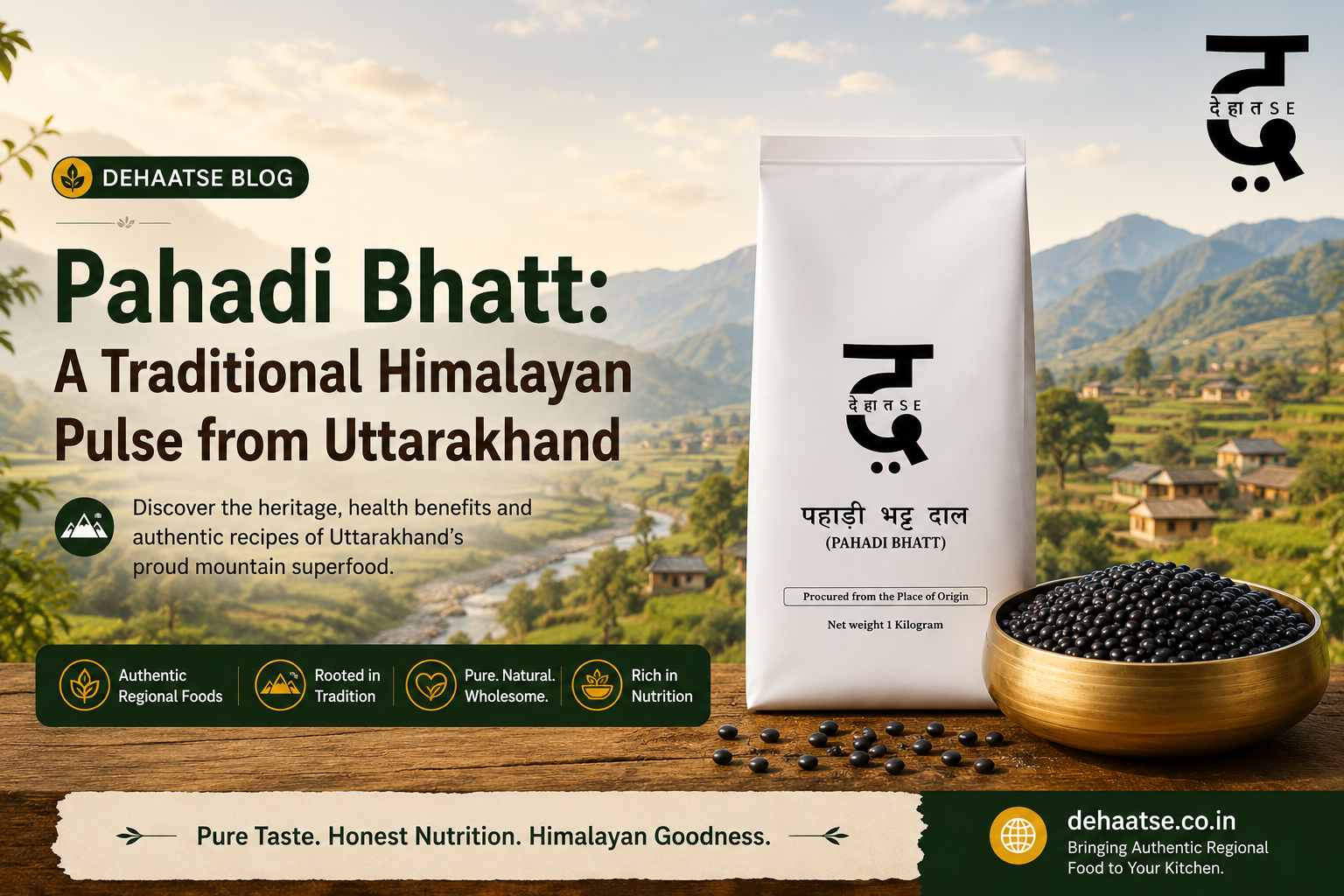
Pahadi Bhatt is a traditional Himalayan pulse closely connected with the food culture of Uttarakhand. Also known as Kala Bhatt in many parts of the region, this dark coloured pulse has been used in mountain kitchens for generations.
Unlike regular yellow dal, Pahadi Bhatt has a dark black or deep brown outer colour. It has an earthy and mildly nutty taste and gives a hearty texture after cooking. It is commonly prepared as dal and is also used in traditional Uttarakhandi dishes such as Bhatt Ki Churdkani and Bhatt Ke Dubke.
Pahadi Bhatt is valued for more than just its taste. It is connected with traditional mountain farming, local food habits and the cooking knowledge passed from one generation to another. For people who want to explore authentic Uttarakhandi food, bhatt is one of the ingredients worth trying.
As a soybean based pulse, Pahadi Bhatt also provides plant based protein, dietary fibre and other nutrients. The exact nutritional value can vary depending on the variety, growing conditions and preparation method.
In this guide, we will understand what Pahadi Bhatt is, where it grows, how it is traditionally cultivated, what makes it different, how it tastes, how to cook it and how to choose and store good quality bhatt.
What is Pahadi Bhatt?
Pahadi Bhatt is a traditional type of dark coloured soybean commonly grown and eaten in the Himalayan regions, especially Uttarakhand. It is often called Kala Bhatt because of its dark appearance.
The beans are generally smaller and darker than many commonly available soybean varieties. Their strong colour remains noticeable even after cooking and gives the prepared dal its distinctive appearance.
Bhatt has traditionally been an important part of the diet in many mountain communities. It can be cooked as dal and is also used in several regional recipes.
One of the reasons people like Pahadi Bhatt is its strong natural flavour. It is not as mild as many yellow dals. It has an earthy taste with a slight nutty note.
The texture also makes it different. When cooked properly, the beans become soft but can still retain some body. This makes the dal filling and suitable for hearty meals.
Pahadi Bhatt is also a useful traditional pulse from a nutrition point of view. As a soybean based food, it naturally provides plant based protein and dietary fibre along with carbohydrates, minerals and other nutrients.
However, nutritional values can differ between varieties and batches. Cooking methods can also affect the final nutritional composition.
For many people in Uttarakhand, bhatt is not simply another pulse. It is connected with the local farms, mountain lifestyle and traditional food culture.
Where Does Pahadi Bhatt Grow?
Pahadi Bhatt is traditionally associated with the hill regions of Uttarakhand. It is grown in areas where mountain farming has been part of local life for generations.
The Himalayan region has different altitudes, temperatures, rainfall patterns and soil conditions. Because of this, farming practices can vary from one area to another.
Regions, Climate & Soil
Traditional mountain agriculture depends heavily on local weather and available land.
Farmers in hilly areas often grow crops that can fit into their local farming systems. Local crop varieties have been maintained because they suit the food habits and farming conditions of the region.
Pahadi Bhatt is one such traditional crop.
The characteristics of bhatt can be influenced by several factors including:
- Growing region
- Altitude
- Soil conditions
- Rainfall
- Temperature
- Farming practices
- Seed variety
- Harvesting conditions
Mountain farms may be small and are often managed differently from large commercial farms.
Traditional farmers have also used different combinations of crops depending on the local climate and farming calendar.
The soil and climate of Uttarakhand do not remain the same across the entire state. The lower hills, middle hills and higher areas can have different farming conditions.
Therefore, it is better not to assume that every batch of Pahadi Bhatt will look or taste exactly the same.
Natural differences can happen from one harvest to another.
The connection between bhatt and the mountain regions is one reason why the pulse has become an important part of Uttarakhandi food culture.
How is Pahadi Bhatt Grown?
Pahadi Bhatt is connected with traditional farming practices followed in Himalayan villages.
The exact farming process can differ according to the location, weather and individual farmer. However, traditional cultivation generally involves preparing the land, selecting suitable seed, sowing during the appropriate season and harvesting after the crop matures.
Traditional Farming & Harvesting
Mountain farming requires farmers to work according to local conditions.
Before sowing, farmers prepare the land and make it suitable for the crop. The seeds are then sown during the appropriate agricultural period.
The timing can depend on rainfall, temperature and the local farming calendar.
As the crop grows, farmers monitor the field and manage it according to their farming practices.
Once the plants mature, the crop is harvested.
After harvesting, the seeds are separated from the plants. The bhatt is then cleaned and dried properly before it is stored or prepared for consumption.
Proper drying is important because excess moisture can affect the quality and storage life of pulses.
Traditional cultivation also plays a role in maintaining local crop varieties.
Local farmers who continue growing traditional crops help keep these varieties available for future generations. At the same time, traditional pulses like bhatt remain connected with local food habits.
This relationship between farming and food is an important part of Himalayan culture.
What Makes Pahadi Bhatt Different?
Pahadi Bhatt stands out mainly because of its appearance, taste and traditional use.
While many Indian dals are yellow, orange or red, bhatt has a naturally dark outer skin.
It also has a stronger flavour than many common dals.
Taste, Texture & Appearance
Pahadi Bhatt generally has:
- Dark black or deep brown colour
- Small to medium sized seeds
- Firm outer skin
- Earthy flavour
- Mild nutty taste
- Hearty cooked texture
- Distinctive aroma when cooked
The dark colour is one of the easiest ways to recognise it.
However, colour alone should not be used to judge quality. Natural variation can occur depending on the seed variety, growing region and harvest.
The texture is another important feature.
When cooked properly, the beans become tender while retaining some body. This gives the dal a more substantial feel compared with softer everyday dals.
The flavour also works well with simple spices.
Cumin, garlic, coriander, chilli and asafoetida can be used to prepare bhatt without covering its natural taste.
This is common with many traditional mountain recipes where simple ingredients are used to bring out the flavour of the main food.
What Does Pahadi Bhatt Taste Like?
Pahadi Bhatt has a rich earthy taste with a mild nutty flavour.
People who are used to regular yellow dal may find its flavour stronger and more noticeable.
The taste can also change depending on how the bhatt is cooked.
Flavour & Cooking Texture
When soaked and cooked properly, the beans become tender.
However, they generally retain some texture instead of becoming completely smooth.
The cooked dal can be thick and hearty.
Traditional spices can add another layer of flavour without taking away the natural taste of the bhatt.
The flavour may be influenced by:
- Seed variety
- Growing region
- Harvest
- Storage
- Soaking time
- Cooking method
- Spices used
A simple preparation with cumin and garlic can highlight the earthy taste.
For a traditional style meal, bhatt can be served with rice, roti or local Himalayan grains.
It also works well with seasonal vegetables.
Because the flavour is strong, you do not need a large number of spices to make a tasty bhatt dish.
How to Cook Pahadi Bhatt Dal?
Pahadi Bhatt is easy to prepare when you give it enough time to soften.
Since it is a whole bean with an outer skin, soaking can be useful before cooking.
Soaking, Cooking & Spices
Here is a simple way to prepare Pahadi Bhatt dal.
Step 1: Clean the bhatt
First, check the bhatt and remove any stones, damaged seeds or other unwanted particles.
Wash it properly with clean water.
Step 2: Soak
Soak the bhatt for several hours.
You can soak it before cooking so that the beans become softer.
Soaking can also help reduce the cooking time.
The exact soaking time can depend on the age and variety of the beans.
Step 3: Cook
Add the soaked bhatt to a pressure cooker or cooking pot.
Add enough water and cook until the beans become tender.
A pressure cooker can make the process faster.
If you are using an open cooking pot, the cooking time may be longer.
Make sure the beans are properly cooked before preparing the final dal.
Step 4: Prepare the tempering
Heat a small amount of cooking fat or oil.
Add cumin, garlic, asafoetida, red chilli and other spices according to your taste.
You can keep the tempering simple because bhatt already has a strong natural flavour.
Step 5: Combine and simmer
Add the cooked bhatt to the tempering.
Mix everything properly and allow it to simmer for some time.
This gives the spices time to mix with the cooked beans.
Adjust the water according to the consistency you prefer.
A thicker preparation works well with rice and roti.
Pahadi Bhatt can also be served with traditional Himalayan grains and seasonal vegetables.
Traditional Pahadi Bhatt Recipes
Bhatt is used in several traditional Uttarakhandi recipes.
Different families and regions can have their own ways of preparing it.
Two popular preparations are Bhatt Ki Churdkani and Bhatt Ke Dubke.
Bhatt Ki Churdkani
Bhatt Ki Churdkani is one of the popular traditional preparations associated with Uttarakhandi cuisine.
It is generally prepared using bhatt along with spices and other ingredients to create a thick and flavourful dish.
The recipe can differ between households.
Some families may use different spices or cooking methods based on their local food traditions.
The main ingredient remains bhatt, which gives the dish its characteristic dark colour and earthy flavour.
Bhatt Ki Churdkani is commonly enjoyed as part of a traditional meal with rice or roti.
Its thick texture makes it a filling dish and its strong flavour pairs well with simple accompaniments.
Bhatt Ke Dubke
Bhatt Ke Dubke is another traditional Uttarakhandi preparation.
It uses a bhatt based mixture that is shaped into small portions and cooked in a spiced gravy.
The preparation shows how local ingredients can be used to create different dishes from the same pulse.
The exact recipe can vary from one household to another.
Traditional recipes like Bhatt Ke Dubke are important because they keep regional cooking methods alive.
They also show the variety available in Uttarakhandi food.
Nutritional Value of Pahadi Bhatt
Pahadi Bhatt is a soybean based pulse and can provide several nutrients as part of a balanced diet.
Like other pulses and legumes, it can contribute plant based protein and dietary fibre.
Protein, Fibre & Other Nutrients
Pahadi Bhatt naturally provides:
- Plant based protein
- Dietary fibre
- Carbohydrates
- Minerals
- Naturally occurring vitamins and micronutrients
The exact nutritional values can vary depending on the crop variety, soil, growing conditions, storage and cooking method.
Protein is one of the main reasons soybean based foods are included in many diets.
For people who eat plant based foods, bhatt can be one of several foods used to add protein to daily meals.
Dietary fibre is another useful part of pulses.
A varied diet that includes pulses, vegetables, fruits, grains and other suitable foods can provide a wider range of nutrients.
It is better to look at bhatt as one part of a balanced diet rather than depending on it as the only source of nutrition.
What Are the Benefits of Pahadi Bhatt?
Pahadi Bhatt can be a useful addition to a varied diet because it provides protein, fibre and other nutrients.
Its traditional whole food nature also makes it suitable for many simple home cooked meals.
Protein, Fibre & Balanced Diet
Some nutritional advantages of Pahadi Bhatt include the following.
Plant based protein
As a soybean based pulse, bhatt naturally provides plant based protein.
It can be included in meals for people who want to add more plant based foods to their diet.
Dietary fibre
Pahadi Bhatt provides dietary fibre.
Fibre is an important part of a balanced diet and is naturally present in many pulses, vegetables, fruits and whole grains.
Filling meals
The combination of protein and fibre can make pulse based meals satisfying.
A bowl of bhatt with rice or roti and vegetables can make a simple and filling meal.
Traditional whole food
Pahadi Bhatt is a traditional pulse that can be prepared at home using basic ingredients.
It does not need to be turned into a highly processed food to be enjoyed.
However, no single food provides everything the body needs.
A balanced diet should include a variety of foods according to individual dietary needs.
Pahadi Bhatt in Uttarakhand Food Culture
Pahadi Bhatt has a special place in Uttarakhandi food culture.
Food traditions in the Himalayan region have been shaped by the local climate, farming conditions and ingredients available to mountain communities.
Traditional Pahadi Cuisine
Traditional Uttarakhandi food includes several local pulses, grains, vegetables, herbs and spices.
Some well known ingredients include:
- Bhatt
- Gahat
- Mandua
- Jhangora
- Local vegetables
- Himalayan herbs
- Regional spices
These ingredients have been used in different combinations to prepare simple and filling meals.
Bhatt represents the close relationship between farming and food in the region.
Farmers grow local crops and families use these ingredients in traditional recipes.
Many recipes are passed from parents and grandparents to younger generations.
This helps preserve the cooking knowledge of the region.
Bhatt is therefore more than a pulse.
It is part of a food tradition that connects local farming, home cooking and the history of mountain communities.
Today, Pahadi Bhatt is also getting attention outside Uttarakhand as more people explore regional Indian foods.
People interested in traditional grains and pulses are looking for ingredients that have a clear connection with their original food culture.
How to Choose Good Quality Pahadi Bhatt?
Choosing good quality bhatt is important for both taste and cooking results.
The beans should look clean and properly dried.
Quality & Authenticity
When buying Pahadi Bhatt, look for beans that are:
- Clean
- Free from excessive dust
- Free from stones and foreign particles
- Relatively uniform in size
- Naturally dark in colour
- Free from visible insect damage
- Properly dried
- Free from unusual or musty smell
The packaging should also be in good condition.
If you are buying packaged bhatt, check the product information, packing date, best-before date and storage instructions.
For authenticity, the source is important.
Look for sellers or brands that clearly mention where the bhatt is sourced from.
If a product claims to be from Uttarakhand, clear information about the sourcing region can give buyers more confidence.
Buying from trusted Himalayan producers or sellers who work with local farmers can also help support traditional crop varieties.
Avoid choosing a product only because the packaging looks attractive.
Look at the actual product information.
How to Store Pahadi Bhatt?
Proper storage can help maintain the quality of bhatt for a longer period.
Pulses should be protected from moisture, insects and direct sunlight.
Storage & Shelf Life
Follow these simple storage steps:
- Make sure the bhatt is completely dry before storage.
- Use a clean and airtight container.
- Keep the container in a cool and dry place.
- Keep it away from direct sunlight.
- Do not allow water or moisture to enter the container.
- Always use a clean and dry spoon.
- Check the beans from time to time for insects or unusual smell.
If you live in a warm or humid environment, refrigeration can also be considered for longer storage.
Before cooking stored bhatt, check for insects, moisture, mould or changes in smell.
The shelf life can vary depending on the quality of the beans, packaging and storage conditions.
For packaged products, always follow the storage instructions provided by the seller or manufacturer.
Pahadi Bhatt vs Other Pulses
Pahadi Bhatt has a different culinary identity compared with many commonly used Indian pulses.
Taste, Nutrition & Usage
| Feature | Pahadi Bhatt | Common Yellow Dal | Rajma |
| Appearance | Dark black or brown | Yellow | Usually red or purple |
| Flavour | Earthy and nutty | Mild | Rich and creamy |
| Texture | Hearty | Softer | Firm or creamy |
| Traditional use | Uttarakhandi cuisine | Everyday Indian dal | Rajma based dishes |
| Protein | Good source | Good source | Good source |
| Culinary identity | Himalayan and Uttarakhandi | Pan Indian | Strongly linked with North Indian cuisine |
The biggest difference is its regional identity.
Yellow dal is used across many parts of India. Rajma is strongly associated with several North Indian dishes.
Pahadi Bhatt, on the other hand, has a strong connection with Uttarakhandi and Himalayan food.
Its dark colour and earthy flavour also make it easy to distinguish from many common dals.
FAQs About Pahadi Bhatt
Is Pahadi Bhatt the same as black soybean?
Pahadi Bhatt generally refers to traditional dark coloured soybean varieties that are grown and eaten in Uttarakhand and other Himalayan areas.
It is commonly known as Kala Bhatt.
The exact variety can differ between regions and farmers.
Is Pahadi Bhatt a type of dal?
Yes.
Bhatt is technically a pulse or legume, but it is commonly cooked and eaten as dal in Uttarakhandi cuisine.
It can also be used to prepare traditional dishes such as Bhatt Ki Churdkani and Bhatt Ke Dubke.
Does Pahadi Bhatt need to be soaked?
Soaking is recommended because it can help soften the beans and may reduce cooking time.
Since bhatt is a whole bean with an outer skin, soaking can make the cooking process easier.
What can I eat with Pahadi Bhatt?
Pahadi Bhatt can be served with rice, roti and traditional Himalayan grains.
It can also be paired with seasonal vegetables and other Pahadi dishes.
A simple combination of bhatt, rice and vegetables can make a satisfying traditional meal.
Is Pahadi Bhatt high in protein?
As a soybean based pulse, Pahadi Bhatt is naturally a source of plant based protein.
The exact amount of protein can vary depending on the variety and growing conditions.
For accurate nutritional information, check the nutrition details provided for the particular product.
What is the difference between Pahadi Bhatt and Gahat Dal?
Pahadi Bhatt and Gahat are both traditional Himalayan pulses, but they come from different crops.
Bhatt is a type of dark coloured soybean, while Gahat is horse gram.
They have different tastes, textures and cooking methods.
Gahat has a distinct earthy flavour, while bhatt has the characteristic nutty and earthy taste of black soybean.
Both are important ingredients in traditional Himalayan food.
Where can I buy authentic Pahadi Bhatt?
Look for sellers who clearly mention the origin and sourcing of the bhatt.
Check the packaging, ingredients, food safety information and storage details before buying.
You can also look for trusted Himalayan producers or brands that work with local farmers.
If authenticity is important to you, clear information about the Uttarakhand source is useful.
Why Pahadi Bhatt Still Matters Today
Pahadi Bhatt is a good example of how traditional Indian foods can remain relevant even as food habits change.
It is a simple pulse, but it carries a strong connection with Uttarakhand’s mountain agriculture and food culture.
Its dark appearance, earthy flavour and hearty texture make it different from many everyday dals.
At the same time, its plant based protein and dietary fibre make it a useful ingredient for a varied diet.
Traditional recipes such as Bhatt Ki Churdkani and Bhatt Ke Dubke show how local families have used the same basic ingredient in different ways.
For anyone interested in traditional Uttarakhand food, Pahadi Bhatt is worth exploring.
It can be cooked at home with simple spices and served with rice, roti or local grains. When sourced properly and stored well, it can become a useful addition to everyday meals.
Most importantly, choosing traditional crops like Pahadi Bhatt can help keep regional food knowledge and local crop varieties connected with everyday cooking.
Pahadi Bhatt is not just another pulse on the kitchen shelf. It is a part of Uttarakhand’s traditional food system, shaped by mountain farming, local ingredients and generations of cooking practices.