
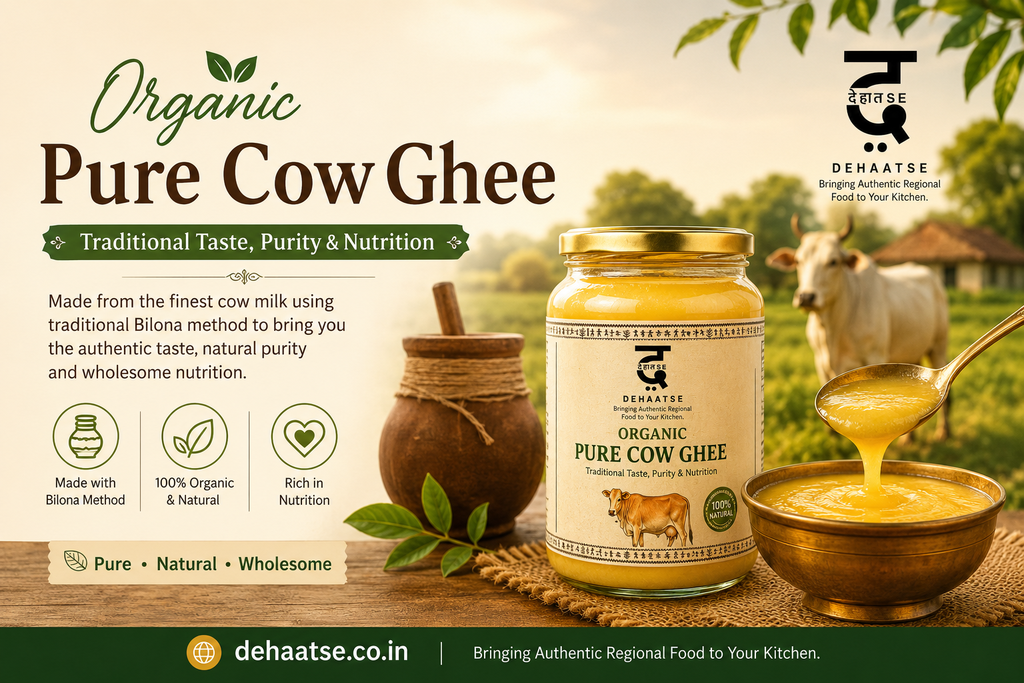
Organic Pure Cow Ghee is a traditional Indian dairy fat known for its rich aroma, smooth taste and wide use in Indian cooking. For many Indian families, ghee is not just a cooking ingredient. It is a part of everyday food and traditional meals.
A small amount of ghee can add a rich taste to dal, rice, roti, paratha and khichdi. It is also commonly used while preparing sweets such as halwa and ladoos. Ghee has been used in Indian homes for generations and continues to be popular today.
The quality of ghee can depend on many things. These include the source of milk, cow feed, dairy practices, processing method, cleanliness, packaging and storage. When buying Organic Pure Cow Ghee, it is important to understand these factors instead of choosing a product only because it has the word organic on the label.
Traditional ghee preparation is also getting attention among consumers. Ghee made using the Bilona method is prepared by first turning milk into curd, churning the curd to separate butter and then heating the butter to make ghee. This method is linked with traditional Indian dairy practices.
In this guide, we will understand what Organic Pure Cow Ghee is, how it is made, what makes it different, where the milk comes from, how it tastes, its nutritional value, traditional uses and how you can choose and store good-quality ghee.
What is Organic Pure Cow Ghee?
Organic Pure Cow Ghee is ghee made from cow’s milk or milk-derived butter, where the word organic refers to the production and sourcing standards followed by the producer.
Ghee is made by removing most of the water and milk solids from butter. After this process, the final product mainly contains milk fat.
Pure cow ghee generally means that the ghee is made from cow’s milk fat. It should not be blended with other edible oils or fats when it is sold as pure cow ghee.
The word organic is slightly different. Organic does not simply mean that the ghee is pure. It refers to the standards followed for sourcing and producing the ingredients. Depending on the product and its certification, these standards can cover areas such as farming practices, animal feed, processing and handling.
This is why buyers should check the complete product information before purchasing organic ghee.
Look at:
- Ingredient information
- Organic certification where applicable
- Milk sourcing information
- Manufacturing details
- Processing method
- Packaging
- Storage instructions
- Best-before date
A product may be traditionally prepared without being certified organic. Similarly, an organic product does not automatically mean that it was made using the traditional Bilona method.
This difference is important when you are looking for Organic Pure Cow Ghee.
Good ghee should have a clean and pleasant dairy aroma. Its colour and texture can change naturally depending on the milk, season, processing method and storage temperature.
How is Pure Cow Ghee Made?
Pure cow ghee can be prepared using different methods. Modern dairy production may use different equipment and processes, while traditional preparation follows a more manual process.
One traditional approach is the Bilona method. In this method, milk is first converted into curd. The curd is then churned to separate butter from buttermilk. The butter is heated slowly to make ghee.
The basic steps are explained below.
Traditional Bilona Method & Preparation
The traditional Bilona method involves several stages. The exact process can vary between producers, but the basic idea remains similar.
1. Milk preparation
Fresh cow’s milk is collected and prepared for processing.
The quality of the final ghee starts with the quality of the milk. Clean milk handling and proper storage are important during this stage.
Milk can come from individual farmers, dairy farms or organised dairy systems. The source and handling practices can affect the characteristics of the final product.
2. Curd formation
The milk is cultured to make curd.
A starter culture is generally used for this process. The milk is allowed to set until it becomes curd.
In traditional preparation, this step is important because the curd is later churned to obtain butter.
3. Churning
The curd is churned to separate butter from buttermilk.
Traditional churning is commonly associated with the Bilona method. The process can be done using traditional tools or suitable modern equipment depending on the producer.
The butter separates from the liquid part and can then be collected.
4. Butter collection
The separated butter is collected and prepared for heating.
At this stage, the butter still contains water and milk solids. These need to be removed to produce ghee.
5. Slow heating
The butter is heated gently.
During heating, the water evaporates and the milk solids separate from the milk fat. The heating needs attention because excessive heating can affect the smell, colour and taste of the final product.
Traditional ghee making often focuses on slow and careful heating.
6. Filtering
After heating, the ghee is filtered to remove the remaining milk solids.
The final ghee is then allowed to cool and may become semi-solid or grainy depending on temperature and other factors.
The exact preparation process can be different from one producer to another. Traditional Bilona preparation is mainly valued for its connection with traditional Indian dairy practices and the flavour it can produce.
What Makes Pure Cow Ghee Different?
Pure cow ghee has a different taste and aroma compared with many other cooking fats.
The difference can come from the milk source, cow feed, season, processing method and storage conditions.
A good-quality cow ghee may have:
- Rich dairy aroma
- Mildly nutty flavour
- Buttery taste
- Golden-yellow to deeper yellow colour
- Smooth or slightly grainy texture
- Clean finish
- Pleasant smell when heated
However, these features can naturally change.
Taste, Aroma, Colour & Texture
The taste of ghee can depend on the milk used and the way it is processed.
Some ghee may have a mild and soft dairy taste. Traditional ghee may have a stronger aroma and slightly nutty flavour.
The colour can range from pale yellow to deeper golden yellow. Colour can be affected by the cow’s diet, milk composition, season and processing.
Texture can also change with temperature.
At warmer temperatures, ghee may become completely liquid. In cooler weather, it may become semi-solid or develop a grainy or crystalline texture.
This means that colour and texture alone cannot prove whether ghee is pure or not.
A clean smell and taste are more useful for noticing obvious quality problems. A strong rancid smell, chemical-like smell or unusual taste may indicate a quality issue.
Where Does the Milk for Cow Ghee Come From?
The quality of cow ghee begins with its milk source.
Milk used for ghee can come from different dairy systems. These may include individual farmers, dairy cooperatives, organised farms and specialised dairy producers.
The production system can vary from one supplier to another.
Sourcing & Dairy Practices
When choosing cow ghee, it is useful to understand where the milk comes from and how it is handled.
Some important factors include:
- Cow breed
- Animal feed
- Dairy hygiene
- Milk collection
- Milk storage
- Transportation
- Processing
- Packaging
- Storage conditions
Cow feed can influence the characteristics of milk. Seasonal changes can also affect milk composition.
Clean dairy practices are important because milk is a food product and needs proper handling from collection to processing.
For organic ghee, buyers should look for suitable organic certification or clear information about the standards followed by the producer.
The word organic should not be treated as proof by itself.
A reliable producer should provide clear information about the product, ingredients, manufacturing details and applicable certification.
Transparent sourcing can help consumers make a better buying decision.
What Does Pure Cow Ghee Taste Like?
Pure cow ghee generally has a rich buttery flavour with a mildly nutty taste.
When ghee is heated, its aroma becomes stronger. This is one reason why it is widely used in Indian cooking.
A small amount of ghee added to hot dal or rice can change the taste and aroma of the complete dish.
Aroma, Flavour & Texture
The flavour of cow ghee can vary depending on:
- Milk source
- Cow diet
- Season
- Processing method
- Heating temperature
- Storage conditions
Traditional ghee may have a stronger dairy aroma compared with some commercially processed products.
Texture can also change according to temperature.
During cold weather, ghee can become thick or grainy. During hot weather, the same ghee can become completely liquid.
This is a natural change and does not automatically mean that the ghee has gone bad.
Good-quality ghee should generally have a clean and pleasant smell. If it smells strongly rancid or has an unusual chemical-like smell, it is better not to use it.
Nutritional Value of Cow Ghee
Ghee is mainly milk fat. It is therefore a concentrated source of energy.
Fat provides approximately 9 calories per gram. Because ghee contains a high amount of fat, even a small serving provides a significant amount of calories.
Ghee also contains naturally occurring fat-soluble vitamins in varying amounts. The exact nutritional composition can depend on the milk source and processing method.
Fats, Calories & Fat-Soluble Vitamins
The main nutritional characteristics of ghee include:
- High fat content
- Concentrated source of energy
- Fat-soluble vitamins in varying amounts
- Naturally occurring dairy components in small quantities
The exact nutrition can differ between products.
This is why the nutrition label can be useful when comparing packaged ghee.
Ghee should be treated as a cooking fat rather than a food that needs to be consumed in large quantities.
Because it is calorie-dense and contains a substantial amount of saturated fat, portion size matters.
A balanced diet can include different sources of fat and other nutrients. Ghee can be one part of that diet.
What are the Benefits of Cow Ghee?
Cow ghee has been used in Indian households for generations.
Its main practical benefit in cooking is that it adds flavour, aroma and richness to food. It can also provide concentrated dietary energy.
Balanced Diet & Traditional Uses
Cow ghee can:
- Add flavour to food
- Add richness to meals
- Provide dietary energy
- Help carry fat-soluble flavours during cooking
- Improve the texture of some dishes
- Work well in traditional Indian recipes
Ghee is also easy to use in everyday cooking.
You can add it to dal, rice, roti, paratha and khichdi. It can also be used in many Indian sweets.
At the same time, ghee is mostly fat. It contains calories and a considerable amount of saturated fat. So it is better to consume it in suitable portions.
Traditional claims about ghee should also be understood carefully. Traditional use and modern medical evidence are not always the same thing.
Ghee can be part of a balanced diet, but it should not be considered a treatment for a health problem.
How to Use Cow Ghee in Everyday Cooking?
Cow ghee is a useful cooking ingredient because it works with many Indian foods.
You do not need a large amount to add flavour. A small quantity can be enough for many dishes.
Dal
Ghee can be used to prepare tadka for dal.
Heat a small amount of ghee and add ingredients such as cumin, garlic, chilli or other spices according to the recipe.
Pour the tadka over hot dal and serve.
The aroma of ghee and spices can make simple dal more flavourful.
Roti
Ghee can be brushed over hot roti.
It can also be used with paratha and other Indian flatbreads.
Some people prefer a light layer of ghee while others like more. The quantity can be adjusted according to personal preference.
Rice
A small amount of ghee can be mixed into freshly cooked rice.
It works especially well with dal, rajma and khichdi.
Ghee can also be used when preparing pulao and other rice dishes where its flavour matches the recipe.
Cooking
Ghee can be used for sautéing, roasting and frying depending on the dish.
Its rich flavour makes it suitable for many traditional Indian recipes.
The quantity should depend on the recipe and overall diet.
Indian sweets
Ghee is an important ingredient in many Indian sweets.
It is commonly used in preparations such as:
- Halwa
- Ladoos
- Besan preparations
- Some traditional festive sweets
- Various regional desserts
The amount of ghee used depends on the recipe.
Cow Ghee in Traditional Indian Food Culture
Ghee has a long connection with Indian food culture.
It has been used in everyday meals as well as festive food for generations.
In many Indian homes, ghee is commonly served with dal, rice, roti and khichdi. It is also used while preparing sweets during festivals and family occasions.
Ayurvedic & Culinary Traditions
Ghee also has a place in traditional Ayurvedic practices.
Historically, it has been used in different traditional preparations. However, traditional use should not automatically be considered proof that ghee can prevent or treat a particular disease.
Modern health decisions should be based on suitable medical and nutritional advice.
From a food point of view, the role of ghee is simple.
It adds flavour, aroma and richness to food.
Its use in Indian cooking has continued because it works well with many traditional recipes and is easy to include in everyday meals.
Organic Ghee vs Regular Ghee
Organic and regular ghee are both forms of ghee. The main difference is generally related to the sourcing and production standards followed by the producer.
Organic ghee is produced according to applicable organic standards and may carry suitable certification depending on how and where it is marketed.
Regular ghee may come from conventional dairy systems.
The word organic does not automatically mean that the ghee was made using the Bilona method.
Similarly, Bilona ghee does not automatically mean that the product is certified organic.
Sourcing, Processing & Quality
| Feature | Organic Cow Ghee | Regular Cow Ghee |
| Milk source | Produced under applicable organic standards | May come from conventional dairy systems |
| Certification | Suitable certification should be checked where marketed as certified organic | Generally not required as organic certification |
| Processing | Can use traditional or modern methods | Can use traditional or industrial methods |
| Ingredients | Should meet applicable organic product standards | Depends on the producer |
| Quality | Depends on sourcing and processing | Depends on sourcing and processing |
This comparison shows why consumers should look at the complete product information.
If you want organic ghee, check the certification and production details.
If you want Bilona ghee, check whether the producer clearly states that the product is prepared using the Bilona method.
If you want pure cow ghee, check the ingredients and product description.
These are different things and should not be confused.
How to Identify Pure Cow Ghee?
Choosing good ghee can be difficult if you only look at colour.
There are many things that can affect the appearance and texture of ghee naturally.
Aroma, Texture, Colour & Quality Checks
Here are some basic things you can check.
Aroma
Good-quality ghee usually has a pleasant dairy aroma.
It may have a buttery or mildly nutty smell.
A strong rancid smell or unusual chemical-like smell can be a warning sign.
Texture
Ghee can be liquid, semi-solid or grainy.
The texture can change with temperature.
A grainy texture does not automatically prove purity. Similarly, completely liquid ghee is not automatically impure.
Colour
Cow ghee can be pale yellow, yellow or deeper golden yellow.
The colour can change because of milk source, cow diet, season and processing.
Therefore, colour alone should not be used as a purity test.
Ingredients
Always check the ingredient list.
If a product is sold as pure cow ghee, the product information should clearly explain what it contains.
This is one of the simplest checks you can make before buying.
Certification and source
If you are buying organic ghee, check the applicable organic certification.
Also look at the producer’s information and sourcing details.
A product with clear information is easier to evaluate than one that only makes broad claims without giving details.
Be careful with home purity tests
Many home ghee purity tests are shared online.
These tests may look simple but they cannot always confirm purity.
Some types of adulteration require proper food testing to identify.
So home tests should not be treated as a final laboratory confirmation.
How to Store Cow Ghee?
Proper storage helps maintain the quality and flavour of ghee.
Ghee has very little water and most milk solids are removed during preparation. Because of this, it is relatively stable compared with many other dairy products.
Still, poor storage can affect its quality.
Container, Temperature & Shelf Life
Follow these simple storage practices:
- Store ghee in a clean and dry container.
- Keep water and moisture away from the jar.
- Always use a clean and dry spoon.
- Keep the container away from direct sunlight.
- Avoid keeping it near excessive heat.
- Close the lid properly after every use.
- Follow the storage instructions given on the product label.
Ghee can generally be stored at room temperature when kept properly. However, the manufacturer’s instructions should always be followed.
Refrigeration can make ghee harder or more solid. This change in texture does not necessarily mean that the ghee has spoiled.
Before using old ghee, check its smell and appearance.
If you notice a strong unusual smell, strange taste, mould or other signs of spoilage, it is better not to use it.
The shelf life also depends on the manufacturing process, packaging and storage conditions.
Always check the best-before date printed on the pack.
How Much Ghee Should You Consume?
There is no single amount of ghee that is suitable for every person.
The right quantity depends on your overall diet, calorie intake, other sources of fat and individual nutritional needs.
Moderation & Balanced Diet
Ghee is calorie-dense and contains a substantial amount of saturated fat.
For this reason, it is better to use it in moderation.
Instead of thinking that more ghee means more health benefits, it is better to look at ghee as one cooking fat that can be included in a balanced diet.
For example, if your meals already contain several sources of fat, you may not need a large amount of additional ghee.
You can use a small amount to add flavour to your food.
The suitable amount can also vary from person to person based on dietary needs and health considerations.
If you have a specific health or diet concern, it is better to speak with a qualified doctor or diet professional before making major changes to your diet.
FAQs About Organic Pure Cow Ghee
What is pure cow ghee?
Pure cow ghee is clarified milk fat made from cow’s milk or milk-derived butter. During preparation, most of the water and milk solids are removed, leaving mainly milk fat.
What is Bilona ghee?
Bilona ghee refers to ghee made using a traditional preparation process. Milk is first cultured into curd. The curd is then churned to separate butter from buttermilk. The butter is heated to make ghee.
Is organic ghee the same as Bilona ghee?
No. Organic and Bilona describe different things.
Organic refers to the applicable sourcing and production standards.
Bilona refers to a traditional preparation method.
A ghee product can be organic, Bilona or both depending on how it is produced and certified.
What does pure cow ghee taste like?
Pure cow ghee generally has a rich buttery flavour with a mild nutty taste and a characteristic dairy aroma.
The exact taste can change depending on the milk source, cow feed, processing method and storage.
Can cow ghee be used for cooking?
Yes. Cow ghee is widely used for cooking, sautéing, tempering, roasting and preparing Indian dishes and sweets.
It can be used in both everyday cooking and festive food.
Can I use ghee for dal and rice?
Yes.
A small amount of ghee can be added to hot rice. It can also be used to prepare a tadka for dal.
Ghee pairs well with dal, rice, rajma and khichdi.
How can I check whether ghee is pure?
Start by checking the ingredient list, source, certification where applicable and information about the producer.
You can also check the smell, taste, colour and texture for obvious quality problems.
However, sensory checks cannot prove purity in every case. Some types of adulteration can only be confirmed through proper food testing.
Does ghee need to be refrigerated?
Not necessarily.
Properly prepared and packaged ghee can generally be stored at room temperature when kept in a clean, dry and airtight container.
However, always follow the storage instructions provided by the manufacturer.
How long does cow ghee last?
The shelf life depends on how the ghee was produced, packaged and stored.
Always check the best-before date on the product and follow the storage instructions.
If the ghee develops an unusual smell, taste or visible signs of spoilage, do not use it.
Is cow ghee healthy?
Cow ghee can be included in a balanced diet.
However, it is a concentrated source of fat and calories and contains a substantial amount of saturated fat.
It is better to consume it in suitable portions rather than assuming that consuming more ghee will provide more health benefits.
Final Thoughts on Organic Pure Cow Ghee
Organic Pure Cow Ghee has an important place in Indian cooking because of its rich taste, aroma and traditional use.
The quality of ghee depends on several factors including milk source, dairy practices, processing, packaging and storage.
If you prefer traditional ghee, you can look for products that clearly explain their Bilona preparation method. If you specifically want organic ghee, check the applicable organic certification and production information.
Do not judge ghee only by its colour or texture. Natural changes can happen because of milk source, season and temperature.
The best approach is to check the ingredients, certification, source, processing details, packaging and storage instructions.
Whether you use it with dal and rice, spread it on hot roti or use it for traditional sweets, ghee can be a useful cooking ingredient when consumed in the right quantity.
Good-quality ghee is ultimately about more than a label. It is about clear sourcing, proper preparation, clean handling and suitable storage.