
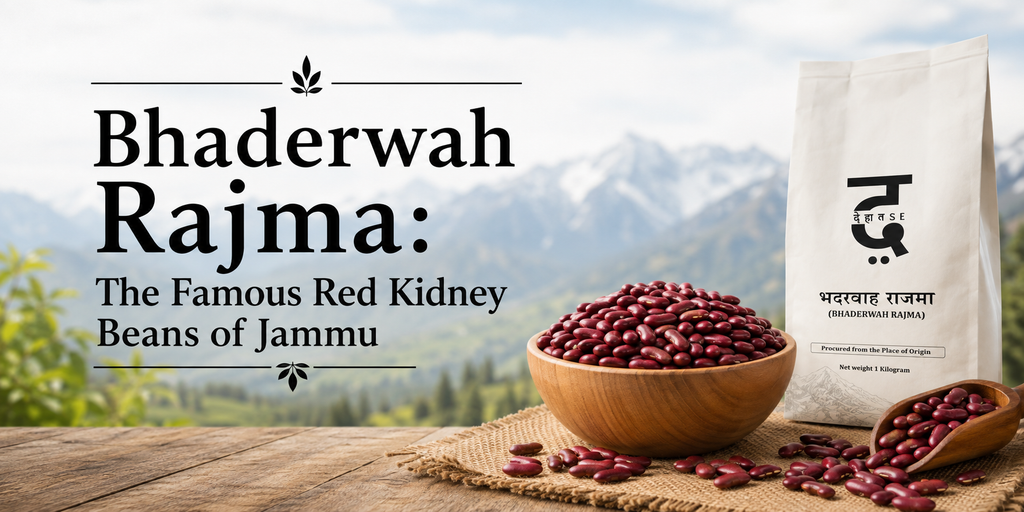
Bhaderwah Rajma is a traditional type of red kidney bean associated with the Bhaderwah region of Jammu and Kashmir. It is grown in the Himalayan areas around the Bhaderwah Valley and is known for its distinct colour, earthy flavour and soft texture after cooking.
Rajma is already a popular food across India, especially when served with rice as the much-loved Rajma Chawal. But Bhaderwah Rajma has its own regional identity. Its relatively small to medium size, rich taste and ability to take in the flavours of spices make it a popular choice among people who enjoy traditional rajma.
The natural conditions of the Bhaderwah region also play an important role in the identity of this bean. Mountain climate, local soil, rainfall, altitude and traditional farming practices can all influence the characteristics of crops grown in the area.
Bhaderwah Rajma is also connected with the food culture of Jammu and the Himalayan region. For generations, local farmers have grown traditional pulses and used them in simple home cooked meals.
Apart from its taste, rajma is also valued as a source of plant based protein, dietary fibre and carbohydrates. It can be included in a balanced diet along with rice, roti, vegetables and other foods.
In this guide, we will explore what Bhaderwah Rajma is, where it is grown, how it is cultivated, what makes it different, how it tastes, how to cook it, its nutritional value, storage and how to choose authentic Bhaderwah Rajma.
What is Bhaderwah Rajma?
Bhaderwah Rajma is a traditional kidney bean associated with Bhaderwah and the surrounding Himalayan areas of Jammu and Kashmir.
Bhaderwah is known for its mountain landscape and agricultural traditions. Farmers in the region have traditionally grown different crops suited to local conditions, including varieties of rajma.
Rajma belongs to the legume family. Like other beans, it naturally provides plant based protein, dietary fibre and carbohydrates.
What makes Bhaderwah Rajma interesting is its regional identity. It is not simply another packet of red kidney beans. The name is connected with the place where traditional varieties have been grown and used as part of local food habits.
The beans can vary in size and colour depending on the particular local variety and growing conditions. Many Bhaderwah Rajma varieties are relatively small to medium in size and have red or reddish shades.
When cooked properly, the beans become soft and creamy while still holding their shape.
Bhaderwah Rajma is commonly prepared with onion, tomato, ginger, garlic and Indian spices. It is especially popular with steamed rice.
The famous Rajma Chawal combination is one of the simplest ways to enjoy it.
Where is Bhaderwah Rajma Grown?
Bhaderwah Rajma is traditionally associated with the Bhaderwah region of Jammu and Kashmir.
Bhaderwah is located in the Doda district and is surrounded by Himalayan mountains, forests and agricultural areas.
The region has different elevations and local weather conditions. These conditions can influence the crops grown by farmers.
Bhaderwah Valley & Growing Conditions
The growing environment is an important part of the identity of regional crops.
Factors that can affect rajma include:
- Altitude
- Temperature
- Rainfall
- Soil
- Sunlight
- Growing season
- Farming practices
- Seed variety
Mountain agriculture is different from large scale farming in plains.
Farmers have to work according to the local climate and available land. Traditional farming knowledge can help them decide when to sow the crop and when to harvest it.
The soil and weather conditions can also affect the size, colour, texture and flavour of the beans.
This is why a regional bean can have different characteristics from a similar variety grown in another part of the country.
Bhaderwah’s Himalayan setting is therefore an important part of the story of its rajma.
The regional connection is also important for consumers who want to buy authentic Bhaderwah Rajma.
The name alone should not be the only factor. Buyers should also look for clear information about the source and growing region.
How is Bhaderwah Rajma Cultivated?
Bhaderwah Rajma is traditionally cultivated by farmers in the mountainous areas around Bhaderwah.
The exact cultivation process can vary between villages and farms. Farmers generally follow the local agricultural calendar and select the right time for sowing based on weather and growing conditions.
Traditional Farming & Harvesting
Farmers first prepare the land according to the local soil and farming system.
Suitable rajma seeds are then sown during the appropriate growing season.
The crop grows through the season while farmers manage the field according to their traditional practices.
Once the plants mature and the pods are ready, the crop is harvested.
The harvested plants or pods are dried properly.
After drying, the beans are separated from the pods. The seeds are then cleaned to remove unwanted material and prepared for storage.
Proper drying is important because moisture can affect the quality and storage life of dried beans.
Traditional farming also has another important role.
It helps maintain local crop varieties.
When farmers continue growing regional varieties, these crops remain connected with the local food system. Traditional seeds and farming knowledge can continue from one generation to the next.
This relationship between farming and food is an important part of the identity of Bhaderwah Rajma.
What Makes Bhaderwah Rajma Different?
There are many types of rajma available in the Indian market.
They can differ in size, colour, cooking time, taste and texture.
Bhaderwah Rajma is appreciated for its own set of characteristics.
Size, Colour, Taste & Texture
Depending on the local variety, Bhaderwah Rajma can have relatively small to medium sized beans.
Some commonly appreciated characteristics include:
- Distinctive red or reddish colour
- Small to medium bean size
- Earthy flavour
- Mildly sweet taste
- Soft texture after cooking
- Creamy consistency
- Good ability to absorb spices and gravy
The exact appearance can vary from one batch to another.
Traditional crops are not always completely uniform in size and colour.
The cooking quality is one of the main things people notice.
When properly soaked and cooked, good quality rajma becomes tender and soft.
The beans should not remain hard in the centre after proper cooking.
Bhaderwah Rajma also works well with thick gravies because the beans can take in the flavours of onion, tomato and spices.
This makes it especially suitable for traditional rajma preparations.
What Does Bhaderwah Rajma Taste Like?
Bhaderwah Rajma has a rich earthy taste with a mild sweetness.
It is generally known for a balanced flavour that works well with Indian spices.
Flavour & Cooking Texture
When properly cooked, Bhaderwah Rajma becomes soft and creamy.
The beans can hold their shape while becoming tender inside.
This gives the curry a good texture.
The flavour works particularly well with ingredients such as:
- Onion
- Tomato
- Ginger
- Garlic
- Cumin
- Coriander
- Red chilli
- Garam masala
The exact spices can change according to the recipe.
A slow cooked rajma curry allows the beans to absorb the flavour of the gravy.
This is one reason why rajma is such a popular dish with rice.
The combination of soft beans, thick gravy and hot steamed rice creates the classic Rajma Chawal meal.
How to Cook Bhaderwah Rajma?
Dried kidney beans should be prepared properly before eating.
Soaking is commonly recommended because it helps soften the beans and can reduce cooking time.
Soaking, Cooking & Spices
Step 1: Wash and sort
First, spread the rajma on a clean plate or tray.
Remove stones, damaged beans and any foreign particles.
Wash the beans properly with clean water.
Step 2: Soak
Put the washed rajma in a large bowl and add plenty of water.
Soak for around 8 to 12 hours.
An overnight soak is convenient for most home cooking.
The beans absorb water and become softer during soaking.
Step 3: Cook until tender
Drain the soaking water.
Add fresh water and cook the rajma until completely tender.
A pressure cooker can make the process faster.
The exact cooking time can vary depending on the age, size and storage condition of the beans.
Do not judge cooking only by time.
The beans should be properly cooked and soft before you add them to the gravy.
Step 4: Prepare the masala
For a traditional rajma curry, prepare a masala using ingredients such as onion, tomato, ginger, garlic, cumin, coriander and chilli.
You can adjust the spices according to your taste.
Cook the masala properly so that the raw smell goes away.
Step 5: Combine and simmer
Add the cooked rajma to the masala.
Mix everything properly.
Add some cooking water if required and let the rajma simmer.
Slow simmering allows the beans to take in the flavour of the gravy.
You can adjust the consistency according to your preference.
Serve hot with steamed rice.
Traditional Bhaderwah Rajma Recipes
Bhaderwah Rajma can be used in different recipes, but the most popular preparation remains Rajma Chawal.
Rajma Chawal & Other Preparations
Rajma Chawal is a simple and comforting Indian meal.
A thick rajma curry is served with hot steamed rice.
The soft beans and spiced gravy work well with plain rice.
The dish can be served with onion, pickle, curd or a simple salad depending on personal preference.
Apart from Rajma Chawal, Bhaderwah Rajma can also be used for:
- Rajma curry
- Spiced rajma gravy
- Rajma with roti
- Mixed bean dishes
- Bean salads
- Modern bean recipes
However, traditional slow cooked preparations are often preferred when you want to enjoy the natural taste of the beans.
Cooking the rajma slowly gives the spices enough time to mix with the beans and gravy.
Nutritional Value of Bhaderwah Rajma
Rajma is a popular legume because it can provide several useful nutrients.
Bhaderwah Rajma is also a natural source of plant based protein and dietary fibre.
Protein, Fibre & Other Nutrients
Bhaderwah Rajma naturally provides:
- Plant based protein
- Dietary fibre
- Complex carbohydrates
- Minerals
- Naturally occurring micronutrients
The exact nutritional values can vary depending on the variety, farming conditions, storage and cooking method.
Rajma can be a useful food for people who want to include more plant based foods in their meals.
Protein is important as part of a balanced diet.
Dietary fibre is also an important part of a healthy eating pattern.
Rajma can be combined with grains such as rice to make a satisfying meal.
A meal of rajma and rice can provide carbohydrates along with protein and fibre from the beans.
However, a balanced diet should include a variety of foods.
No single pulse can provide every nutrient needed by the body.
Adding vegetables, fruits, grains and other suitable foods can help create a more varied diet.
What Are the Benefits of Bhaderwah Rajma?
Bhaderwah Rajma can be included in a balanced diet as a useful source of plant based nutrients.
Its combination of protein, fibre and carbohydrates can make it a satisfying food.
Protein, Fibre & Balanced Diet
Plant based protein
Rajma is naturally a source of plant based protein.
It can be useful for people who want to include more beans, pulses and other plant based foods in their diet.
Dietary fibre
Rajma provides dietary fibre.
Including fibre rich foods in a varied diet can help increase overall fibre intake.
Satisfying meals
The combination of protein, fibre and carbohydrates can make rajma based meals filling.
Rajma Chawal is a good example of a simple meal built around a pulse and a grain.
Versatile ingredient
Rajma can be used in many recipes.
It can be prepared as a curry, served with rice or roti, added to salads or used in modern bean based dishes.
The important thing is to include it as part of a varied diet rather than treating it as a complete source of nutrition by itself.
Bhaderwah Rajma in Jammu’s Food Culture
Rajma has an important place in the food traditions of Jammu and the Himalayan region.
Traditional food in mountain areas has often depended on locally available crops and ingredients.
Local Cuisine & Traditional Food
Pulses have traditionally been useful in mountain food systems because they can be stored for longer periods when properly dried.
Rajma can be stored as a dried food and prepared when needed.
In Jammu and nearby Himalayan areas, rajma is used in everyday meals as well as traditional food preparations.
Bhaderwah Rajma represents the connection between local farming and regional cooking.
Farmers grow the beans in the local environment.
Families then use them with ingredients such as onion, tomato, garlic and spices.
Rice makes a natural partner for rajma, which is why Rajma Chawal has become popular far beyond its regional origins.
The food is simple but satisfying.
The regional variety of rajma adds another layer to this food tradition.
Bhaderwah Rajma vs Regular Rajma
Bhaderwah Rajma and other commercially available rajma can look similar, but they may differ in size, colour, flavour and cooking behaviour.
Taste, Texture & Cooking Time
| Feature | Bhaderwah Rajma | Regular Rajma |
| Appearance | Often small to medium sized | Can be larger depending on variety |
| Colour | Red or reddish shades | Red, dark red or other shades |
| Flavour | Earthy and mildly sweet | Varies by variety |
| Texture | Soft and creamy when cooked | Varies by variety |
| Cooking | Usually needs soaking | Usually needs soaking |
| Culinary use | Rajma Chawal and regional dishes | Curries, Rajma Chawal and other dishes |
It is important to understand that regular rajma is not one single variety.
There are many types of kidney beans available in the market.
Some are large while others are small.
Some have a light red colour while others are darker.
Cooking time can also change from one variety to another.
Therefore, the comparison should not be seen as Bhaderwah Rajma being better in every situation.
Its main difference is its regional identity and the taste and texture associated with the traditional varieties grown around Bhaderwah.
How to Choose Good Quality Bhaderwah Rajma?
Buying a regional food product requires some attention to its source.
The name Bhaderwah Rajma is connected with a specific region, so origin information is useful.
Colour, Size & Authenticity
When buying Bhaderwah Rajma, look for beans that are:
- Clean
- Properly dried
- Free from excessive dust
- Free from stones and foreign material
- Free from insects
- Free from visible damage
- Relatively uniform in size
- Naturally coloured
- Free from unusual or musty odours
The beans should look dry and suitable for storage.
If buying packaged rajma, check the packaging carefully.
Look at the:
- Product name
- Source information
- Packing date
- Best-before date
- Storage instructions
- Seller details
- Food safety information
Authenticity
Origin is especially important when buying Bhaderwah Rajma.
A seller should ideally be able to provide information about where the beans were sourced.
Look for details about:
- Growing region
- Farmer or producer
- Sourcing area
- Packaging
- Food safety
- Seller information
Be careful with products that use the name of a famous regional food but do not provide any useful information about its origin.
Packaging alone cannot prove authenticity.
Clear sourcing information gives buyers a better idea about what they are purchasing.
How to Store Bhaderwah Rajma?
Dried rajma can be stored for a reasonable period when kept in suitable conditions.
The main things to protect it from are moisture, insects, heat and direct sunlight.
Storage & Shelf Life
Follow these simple storage steps:
- Keep the beans in a clean and airtight container.
- Store the container in a cool and dry place.
- Keep moisture away from the beans.
- Avoid direct sunlight.
- Keep the beans away from strong smelling foods.
- Use a clean and dry spoon or cup when taking out the beans.
- Check the beans from time to time for insects or changes in smell and appearance.
If you live in a very hot or humid area, refrigeration can be considered for longer storage.
Always allow the beans to remain dry before storing them.
Moisture can increase the chance of spoilage.
For commercially packaged Bhaderwah Rajma, follow the storage instructions given on the package.
Also check the best-before date.
If the beans develop an unusual smell, visible mould or signs of insects, they should not be used.
FAQs About Bhaderwah Rajma
Where does Bhaderwah Rajma come from?
Bhaderwah Rajma is traditionally associated with Bhaderwah and the surrounding Himalayan areas of Jammu and Kashmir.
Bhaderwah is located in the Doda district and has a long connection with mountain agriculture.
Is Bhaderwah Rajma different from normal rajma?
Yes.
Bhaderwah Rajma refers to traditional regional varieties associated with the Bhaderwah area.
Its size, colour, flavour and cooking characteristics can differ from other commercial varieties of rajma.
However, regular rajma is not one single variety, so there can be considerable variation among commercially available beans.
Does Bhaderwah Rajma need to be soaked?
Yes.
Soaking dried rajma for several hours before cooking is generally recommended.
It helps soften the beans and can reduce the cooking time.
How long should Bhaderwah Rajma be soaked?
An overnight soak of around 8 to 12 hours is commonly suitable for dried kidney beans.
The exact time can vary depending on the age and condition of the beans.
What is the best way to eat Bhaderwah Rajma?
One of the most popular ways is Rajma Chawal.
Cooked Bhaderwah Rajma is prepared in a spiced gravy and served with hot steamed rice.
It can also be served with roti or used in other bean based dishes.
Is Bhaderwah Rajma a good source of protein?
Yes.
Like other beans and legumes, Bhaderwah Rajma naturally provides plant based protein.
The exact protein content can vary depending on the variety and growing conditions.
How should Bhaderwah Rajma be stored?
Keep dried rajma in a clean airtight container.
Store it in a cool and dry place away from moisture, direct sunlight and insects.
For longer storage in hot or humid conditions, refrigeration can be considered.
How can I identify authentic Bhaderwah Rajma?
The best way is to check the source and origin information.
Look for sellers who clearly mention where the beans were grown or sourced.
Do not rely only on the name printed on the package.
A trustworthy seller should be able to provide useful information about sourcing and product details.
Why Bhaderwah Rajma is Worth Trying
Bhaderwah Rajma is more than a regular kidney bean. Its regional identity, traditional cultivation and connection with Jammu’s food culture make it an interesting ingredient for people who enjoy regional Indian foods.
Its earthy flavour, mildly sweet taste and soft texture make it especially suitable for rajma curry and Rajma Chawal.
The beans can also be used in other traditional and modern recipes.
From a nutrition point of view, Bhaderwah Rajma provides plant based protein, dietary fibre and carbohydrates. It can be included as part of a balanced diet along with vegetables, grains and other foods.
When buying it, pay attention to the source. Since Bhaderwah is part of the identity of this regional food, clear origin information is important.
Choose clean and properly dried beans from a trusted seller. Store them away from moisture and insects and soak them properly before cooking.
For anyone who enjoys traditional Jammu cuisine or wants to try regional Indian pulses, Bhaderwah Rajma is a simple and tasty choice. Its connection with the Bhaderwah Valley gives the humble kidney bean a distinct place in the food culture of the Himalayan region.